Sunday, March 7, 2010

Getting what we voted for . . .

One of the surest ways to track a society's values is to track how it spends its public money when money's tight.

Our Republican governor, Bob McDonnell, has proposed dealing with the state's troubled economy through massive cuts to public schools, the state government work force and health and welfare safety net programs in a $2.1 billion bid to balance a critically troubled state budget.

He also proposed that public safety see a boost of $60 million in funding over the biennium.

Which seems to be saying that our governor suggests we will increasingly deal with troubled people if they break the law, at which point we lock them up.


Another way to track our values is to examine how we protect diversity.

This article ran in this morning's Washington Post's "Virginia section:" 
Virginia Attorney General to colleges: End gay protections
By Rosalind S. Helderman
Washington Post Staff Writer
Saturday, March 6, 2010; A01
RICHMOND -- Virginia Attorney General Ken Cuccinelli II has urged the state's public colleges and universities to rescind policies that ban discrimination on the basis of sexual orientation, arguing in a letter sent to each school that their boards of visitors had no legal authority to adopt such statements.
In his most aggressive initiative on conservative social issues since taking office in January, Cuccinelli (R) wrote in the letter sent Thursday that only the General Assembly can extend legal protections to gay state employees, students and others -- a move the legislature has repeatedly declined to take as recently as this week.
The letter demonstrates an increasing split in the region's policies on issues related to sexual orientation. It comes in the same week that the District began issuing marriage licenses for gay couples and a week after Maryland's attorney general announced that his state will recognize same-sex marriages performed in other states.
Cuccinelli's move has dismayed students and faculty members. It suggests that Cuccinelli intends to take a harder line with the state's university system, where liberal academics have long coexisted uneasily with state leaders in Richmond.
"It is my advice that the law and public policy of the Commonwealth of Virginia prohibit a college or university from including 'sexual orientation,' 'gender identity,' 'gender expression,' or like classification as a protected class within its non-discrimination policy absent specific authorization from the General Assembly," he wrote in the letter.
State government has real power in our lives. I'm curious: When we elected this administration, were these the ways we envisioned that power being used?

Friday, March 5, 2010

If it works, work it . . .

Yesterday I wrote about how our public school classrooms' curricula is becoming more and more politicized. Which I, personally, find terribly worrisome. To me, democracy needs the participation of curious, well-informed minds in order to function effectively. Democracies run on emotion, again in my opinion, generally run into trouble.


Last night, on the WMRA Facebook page, I posted a notice of an upcoming conversation between ATC host Michele Norris and Politico reporter Andy Barr about a leaked memo letting us know about a PowerPoint presentation of the Republican National Committee's fundraising strategy.

From within the trenches of our current ultra-partisan American politics, it's tempting to respond to this memo emotionally. Republicans and Democrats who, in their hearts, only want to defeat the Other Side, can find reason to cheer both the RNC's PowerPoint presentation, and the fact that it's been leaked to the general public. Democrats can enjoy their outrage; Republicans can enjoy the fact that even though they may publicly distance themselves from the sentiments this presentation represents, at least some of their Leadership embrace such tactics enthusiastically.


The page with  the ugly caricatures of President Obama, Nancy Pelosi, and Harry Reid is the one that seems to be generating the most cross-party-line clucking. But it has nothing on it that I have not seen in the political arena before, generating either snickers or outrage along strict party lines, keeping the simplistic flame of partisan politics burning bright.


The one that truly alarms me, however, is the slide that suggests that Republican fundraisers should encourage what they term "visceral giving" through marketing fear, extreme negativity, and "reactionary;" meaning, I guess, that donors will donate in reaction to feeling all that "fear" and "extreme" negativity.

This, in my opinion, is truly ugly, self-destructive stuff. Not so much for Republicans, as for what it reveals about what actually motivates us, the voting public, to participate in our American political system. You see, I do not for one moment think that Republican political strategists are the only ones who think in such gutter terms. They're just the ones who got caught. This time.

This morning, the papers, if they are covering this at all, are reporting Republican efforts at "damage control." The story has already slid down to the small print headlines of washingtonpost.com. I would submit that the story has lost its legs because it offers us, the public, a rare, unstinting picture of how gullible we are to speak, spin, mendacity, manipulation. And we are colossally uncomfortable with what we see.

As Pogo put it, "We have met the enemy and he is us." These gutter tactics were in this leaked RNC PowerPoint only because, time and again, a lot of us voters have parked our reason, our education, and our common sense while we voted on emotion. Politicians of all stripes want votes and will use whatever works best to garner them.

Thursday, March 4, 2010

The truth as a votable issue. . .

Reconciliation looms, as we struggle to reform health care. Somewhere in this messy process, political talking points such as "government takeover of health care" have gained the heft of legitimate concerns. The same politicians who passed pretty massive tax cuts and for seven years paid for wars (or rather did not pay for them) through supplemental funding are now railing against deficit spending. Go figure.

What makes a lot of contemporary politicians run? The truth? The greater good? Their own internal ethics? Greed? A hunger for power? A desperate desire to pander their way to re-election? You tell me.  I'm in a rare gloomy mood this morning, it seems, when it comes to issues of governance.

What I do know is that it takes a critical mass of well-educated voters for the American political system to function effectively.  That's why I was alarmed to see on the front page of this morning's New York Times (amidst news of election strife in Iraq, what's happening in health care, and Hollywood's latest payment structure), an article headed Darwin Foes Add Warming to Targets. 

The article goes on to detail how conservative Christian critics of the Theory of Evolution  run up against separation of church and state in their attempts to require schools to teach Christian creationism as a viable alternative theory. So in the last year or so, they have begun to link their issue to the issue of global warming.

According to the article:
The linkage of evolution and global warming is partly a legal strategy: courts have found that singling out evolution for criticism in public schools is a violation of the separation of church and state. By insisting that global warming also be debated, deniers of evolution can argue that they are simply championing academic freedom in general.
Okay, let the debate rage, say I. Academic freedom is a good thing. But then I read this:
Last year, the Texas Board of Education adopted language requiring that teachers present all sides of the evidence on evolution and global warming.
And this:
In South Dakota, a resolution calling for the “balanced teaching of global warming in public schools” passed the Legislature this week.
“Carbon dioxide is not a pollutant,” the resolution said, “but rather a highly beneficial ingredient for all plant life.”
The measure made no mention of evolution, but opponents of efforts to dilute the teaching of evolution noted that the language was similar to that of bills in other states that had included both. The vote split almost entirely along partisan lines in both houses, with Republicans voting for it and Democrats voting against.
And it was brought forcefully home to me that our state legislatures have begun legislating our schools' curricula.

If you believe, as I do, that a good education doth an open-minded person make, do we really want what our kids are taught in school dictated by politicians?

It's a fair question, don't you think?

Wednesday, March 3, 2010

Unfathomable paradox . . .

Here's a kind of  a visual representation of a paradox for you to ponder in preparation for reading today's post.


Today's entry comes from Tom Graham, who's been closely following the doings of the Virginia General Assembly.
Hey Martha -

One of the reasons politics fascinates me is because different people can view the exact same phenomenon in completely different ways. What one sees as an unfathomable paradox, another reads as supremely logical and fair.

House of Delegates Member Ben Cline (R-Rockbridge) reminded me of this recently.

We were talking about the ongoing debate in Richmond over coping with a more than 4 billion dollar revenue shortfall.

According to House Republicans, and Governor Bob McDonnell, a number of jobs bills the governor has championed in the midst of the budget crisis will create 29,000 new jobs.

But Democrats claim that funding reductions Republicans have pushed through the House would mean elimination of more than 34 thousand jobs in Education and Health Care fields alone. To say nothing of other job losses coming from GOP favored spending cuts in other areas of state government.

Is that a paradox ?

Here’s what Ben had to say when I asked him:

“I asked a Democrat friend of mine, when that claim came up during the budget debate on the House floor, whether they differentiate between public sector jobs and private sector jobs. Those that are funded through taxpayer dollars, and those that are not.

The Democrat really did not differentiate. And I tend to.

I tend to believe that those jobs that are borne of the necessity of the public interest to provide those core government services are important. But that the private sector jobs are the lifeblood of our economy.

Those [private sector jobs] are the jobs that we should be striving to create.

And we must do all we can. And if it comes to losing public funded government jobs to support those private sector jobs, then that’s what we have to do.

It is incumbent upon us to make sure our economy recovers quickly. That jobs are created in the private sector.

And by keeping taxes low, streamlining government spending, and eliminating waste and inefficiency -- and if that means eliminating public sector jobs, so be it. Then that’s what we need to do.”

By the way, just how state government will end up dealing with its more than $4 billion shortfall is supposed to be decided before the end of next week.

That is when the House/Senate Conference Committee -- now working to hammer out a final budget compromise -- is due to finish its work.

To find contact info for your state Senator and Delegate, click here.

If anyone has suggestions about what to cut -- or NOT cut -- from the state budget, this would be the time to make sure your state lawmakers hear your voice.

Best,

Tom G.

Note from Tom DuVal:  Close to home, the General Assembly is also working on funding for public radio and television, and for Radio Reading Services for the print-impaired (which includes WMRA's Valley Voice service). The House budget zeros out state funding entirely. The Senate version has a 15% cut, which would be upwards of $20,000 for WMRA/Valley Voice - which we think is a fairer share for us to carry.

Tuesday, March 2, 2010

Danger: Peaceniks at play . . .


There are seemingly inconsequential moments in life that one carries around because they are, in retrospect, highly informative. Here's such a moment from my own life:
It's back in the early 80's. I'm riding (not illegally at the time) in the bed of a pick-up with a friend's two boys, ages six and eight. We are crawling along in traffic in downtown Charlottesville.

The two boys have brand new toy laser guns, of which I, in my peacenik heart, do not approve at all. They are taking aim at people as we ride along, pretending to shoot them, having a high old time. Shades of me, decades ago, the pow-pow-pow-you're-dead kid, shooting the neighborhood gang with sticks. A part of me I've long considered obliterated by years of peace and love.

"Hey Martha!" the eight-year-old says, offering me his brand new toy gun, "You do it!"

The offer is generous as the gun is new. My moralistic mind is caught between wanting to reward generosity and wanting to preach against guns. Any guns. Even toy guns.
Generosity wins. I take the gun and hold it gingerly, pointing down.

"Shoot something!" shout the boys. "It's no fun if you don't shoot something!"

Ah, the slippery slope of toys. I raise the laser gun and point at a passing fire hydrant, pull the trigger, and politely say "kapow."

"Yeah!" the boys bellow. "Shoot something else!".

At that moment we're passing a little old lady who's creeping along the sidewalk. She's the age and shape of all the little old ladies who have held me up in grocery stores by stopping their carts in the middle of the aisle while they read endless labels. I feel a flickering hunger for revenge in my well-disciplined, peaceful heart. The pow-pow kid is still right there inside me. Starved for action. Ready to rumble. I raise the laser, I take aim, I shoot. "Kapow!" I sing out.

To my shame, I realize I am having fun.
What I took with me from this incident is a personal belief that, no matter how strong your convictions, your religion, your practice, violence remains a part of the human make-up. We are what we are, no matter how hard we try to be what we're not. And that we ought to be careful which parts of our make-up we nourish in the name of having fun.

Our culture's romance with astonishingly violent video games has long made me nervous. So it was with  interest that I read a small article in yesterday's Washington Post that cites a study done at Iowa State University, firmly linking violent video games to violent thought and action.
In its review of data, the new research found that exposure to violent video games was associated with aggressive behavior, aggressive cognition and aggressive "affect." It desensitizes users and is associated with lack of empathy and a lack of "prosocial" behavior.
I couldn't reach the actual study. It's published in Psychological Bulletin, which requires a subscription to view. But just reading the Post's summation was enough to take me back to that pick-up truck, that laser gun, and that fantasy.

Kapow!

Monday, March 1, 2010

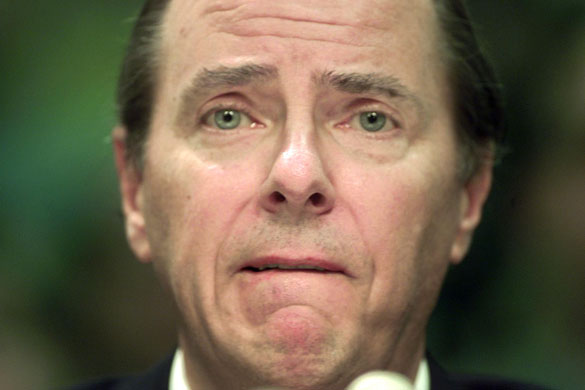
Remember him?


The above photo of Jeffrey Skilling testifying before Congress ran in The Guardian. Which, as I'm sure you know, is a British paper. So yes, the man's spectacular skulduggery as Enron C.E.O. made him world-famous.

Today's arguments before the Supreme Court, however, will address the issue of whether or not in this, the Internet age, did they make him too famous in Houston, Texas, to get a fair trial?

Adam Liptak pondered this question in yesterday's New York Times:
A Houston Chronicle column about his trial on fraud charges was headlined “Your Tar and Feathers Ready? Mine Are.” A rap song appeared called “Drop the S Off Skilling.” And potential jurors in Mr. Skilling’s trial told the court that he was “a high-class crook” who “should be reduced to having to beg on the corner and live under a bridge.”
Not exactly dispassion on two feet, is it?

Mr. Liptak went on to point out:
It has been two decades since the Supreme Court has considered a major change of venue case, and its jurisprudence is still rooted in decisions based on small communities dominated by a single local newspaper and perhaps a few local television news outlets. The law has been slow to adapt to a more general, more intense and yet more atomized media environment.
How potential jurors become informed in the Internet era, experts in jury behavior said, cuts in two directions. It may now be harder than ever for defendants to find wholly untainted jurors in their own communities. At the same time, a change of venue in a truly high-profile case is less likely than ever to solve the problem.
In other words, when Enron sank and took many an  innocent investor and employee with it, we were all Houstonian in our anger at those responsible.

And those responsible certainly included Mr. Skilling--at least according to the Houston jury that convicted him. The question before the Supreme Court today is, was Houston, a city seething with antipathy toward Skilling, the proper venue for his trial?

In today's arguments before the Supreme Court (in a Bloomberg.com report)  . . .
The 12 jurors reflected that antipathy, Skilling contends. During pretrial questioning, three said they were “angry,” three said they had negative feelings toward Skilling or doubted his impartiality and one said that all CEOs were “greedy,” according to his appeal.
What Jeffrey Skilling wants is a new trial, somewhere else. And what I want is to know what you think--did Enron's former CEO get a fair trial? If not, where could he get one in this Internet Age? And, perhaps most tellingly, do you think you could consider evidence impartially as a Skilling trial jury member?

On appeal, incidentally, are all of Mr.Skilling's 19 convictions. According to court watchers, the Supremes have indicated that they will probably overturn at least one conviction, the one for depriving "another of the intangible right to honest services.”

The case is Skilling v. United States, 08-1394.

Note: Hear what Nina Totenberg had to say about the arguments on Monday's ATC.

Saturday, February 27, 2010

Michelle Obama's right to bare arms and other stylish questions. . .


A year ago, when we were all still getting comfortable with President Barack and First Lady Michelle Obama’s personal style, there was quite a lot of journalistic clucking about Michelle Obama’s arms; that they were so strong and so often on display.

And this clucking came not just from narrowly focused fashionistas, but from the astutely focused pundit—and frequent NPR presence—David Brooks. His discomfort with Ms. Obama’s public display of biceps was ratted out by fellow New York Times columnist Maureen Dowd in a Sunday column she titled "Should Michelle Cover Up?" Ms. Dowd and Mr. Brooks were on their way to the British Embassy . . .
In the taxi, when I asked David Brooks about her [Mrs. Obama's] amazing arms, he indicated it was time for her to cover up. “She’s made her point,” he said. “Now she should put away Thunder and Lightning.”

So what, exactly, was our initial problem with Ms. Obama’s naked arms? Could it have been that we, the American people, were being asked to cope with one style adjustment too many?

Barack Obama, as a candidate, had famously declared America wanted change. Obviously, we voters agreed with him, having had enough of being governed by sartorially conservative, rather prudish people. The Bush Tribe was nothing, if not predictable in their personal style. Remember Attorney General John Ashcroft draping the semi-nude statues in the Great Hall of Justice because he wasn’t comfortable being photographed with them?

First Lady Laura Bush dressed perfectly for her role as that administration’s head spouse -- no non-traditionally naked arms on display for her! Indeed, Mrs. Bush presented us with no fashion surprises of any kind. She understood First Ladies as institutions on two feet, not as fashion forward women who use clothes to give us some sense of who they are.

Of course, we didn't elect Michelle Obama, we elected her husband. And Barack Obama comes with a personal style as well; not so much in what he wears as in how he goes about doing business. We threw out a President who many thought shot from his hip (and was famously ill at ease listening to contrary opinions), for one who has positioned himself as a consensus builder, one who asks us all to be patient while he takes time to be well-informed himself and gives others time to become equally well-informed. President Barack Obama seems to really expect politicians to stop worrying about re-election long enough to actually accomplish things.

Dana Millbank, whom I think watched the entire Health Care Summit, has an interesting column in this morning's Washington Post, called "Obama needs to flex his political muscle," in which he contrasts Gordon Brown's and Bush II's political style (which he sees as bullying) with President Obama's more measured approach:
Here in America, however, we can only watch this [Gordon Brown's bullying] behavior with envy. Our president is not a bully; in fact, he is the victim of bullying. He is bullied by Republicans on health care. He is bullied by congressional Democrats on everything. He is bullied by his own Cabinet. Dick Cheney pauses in his bullying of Obama only for the occasional heart attack.
Admittedly, the allegations against Brown have only hastened his political decline, and there's no need for Obama to start kicking furniture and throwing BlackBerrys at people, as Brown stands accused of doing. Still, it wouldn't hurt for the occupant of the bully pulpit to show some force of will.
His predecessor got a narrowly divided Congress to pass his tax cuts, authorize the Iraq war and give him the Patriot Act, not through logic or eloquence but by bludgeoning, intimidating and threatening holdouts (remember Jim Jeffords or Max Cleland?). Lawmakers weren't swayed by George W. Bush's arguments; they feared retribution.
The problems that plague this country are terribly complex and terribly serious. It seems evident that "talking point" politics are unhelpful in addressing them, yet we Americans seem drastically uncomfortable with anything else. Obama's popularity numbers continue to plummet as he continues to try to work with the people who oppose his ideas, often (it seems) for purely political reasons. He began the year with a 50% approval rating down from 68% last March.

It's a given that we are all worried and all concerned about the country's future as well as our own. My question is what, exactly, do we want this President to do that he is not doing? Are we simply uncomfortable with Barack Obama's consensus-building style?  Do we really want government by political bullying?

Michelle Obama, by the way, has a 78% approval rating. Which means, I guess, that we have gotten quite comfortable with "Thunder and Lightning."