Showing posts with label Supreme Court. Show all posts

Thursday, February 10, 2011

Ginni Thomas' latest move . . .

Politico broke the news last Friday:
Justice Thomas' wife, Virginia, now a lobbyist. 
She started as a congressional aide in the 1980s, became a midlevel Republican operative, then briefly left politics, reemerging in 2009 as founder of a tea party group before stepping down amid continued questions about whether her actions were appropriate for the spouse of a Supreme Court justice. 
Now, Virginia “Ginni” Thomas, wife of Justice Clarence Thomas, has recast herself yet again, this time as the head of a firm, Liberty Consulting, which boasts on its website using her “experience and connections” to help clients “with “governmental affairs efforts” and political donation strategies.
I did have to giggle (with great dignity) at the wording of that phrase, "governmental affairs efforts." But I'm allowed an occasional giggle at wording, don't you think? And I'm allowed to be grateful that the wording wasn't "judicial affairs efforts." But dignified giggling about the wording has nothing to do with the ethics of Ginni Thomas' actions.

The question is, I guess, can wife and husband refrain from influencing each other professionally? And I ask that question as the legality of health care reform barrels toward the Supreme Court.


Clarance and "Ginni" Thomas
Ginni Thomas has mixed it up with the legality of health care reform before in ways she (or her husband or someone) later thought better of. This was posted on the ABC News website on October 21, 2010, when Ms. Thomas was head of the Tea Party group Liberty Central:
More Controversy for Virginia Thomas; First Anita Hill, Now Health Reform Law: Liberty Central Pulls Memo By Wife of Justice Attacking Constitutionality of Health Care Legislation 
Two days after making headlines for reaching out to Anita Hill, Virginia Thomas' non-profit organization has withdrawn her name from a statement that had been posted on its website advocating the repeal of the Obama administration's health care law. 
In a statement, the non-profit group Liberty Central said the organization "assiduously avoids" taking positions on the "constitutionality" of issues. 
The memo posted by Liberty Central came from the Conservative Action Project. Liberty Central said that Virginia Thomas, the wife of Justice Clarence Thomas, was incorrectly listed as the author of the memo. 
On October 27th, NewsOne for Black America joined other news outlets in reporting that Ms. Thomas had stepped down as head of Liberty Central .“She’ll take a back seat so that Liberty Central can continue with its mission without any of the distractions,” the group’s spokeswoman Caitlin Carroll told the Washington Post Monday. “After discussing it with the board, Mrs. Thomas determined that it was best for the organization.”


But now, she's back, with the aim, according to Liberty Consulting's website, of lobbying all those new Tea Party-backed House members.  
With the new ascendancy of constitutional conservatism, Liberty Consulting and Virginia Thomas will continue to serve as a visionary insider who sees political threats, opportunities and can marshal resources to restore our nation's founding principles.

In launching LibertyCentral.org in 2009, Ginni set out to be an "ambassador" between the new citizen activists (tea party movement), the established conservative movement, the entrepreneurial class, the alternative media and principled statesmen and candidates.

Ginni plans to leverage her 30 years of experience as a Washington "insider" to assist non-establishment "outsiders" who share her belief in our core founding principles and values.
 There's a Protect our Elections video posted on YouTube that alleges (with what appears to be strong evidence) that the "office" of  Liberty Consulting is the same P.O. Box used by Liberty Central. Protect our Elections further alleges that:
"both are fake Astroturf organizations putting up a 5 page website and a P.O. box, all to funnel millions of dollars to influence election and legislation, money from donors they don't have to reveal. We call for immediate criminal and ethical investigations to take place surrounding these allegations and we demand that Clarence Thomas get the equal justice under law that everyone else got that came before him seeking justice." 
Conservative firebrand Sean Hannity asks this question on his website: Should Clarence Thomas recuse himself if the Health Care repeal reaches the SCOTUS? And then posts this answer:
All signs point to the Affordable Health Care Act appearing before the Supreme Court sometime next year. This thread really isn't to debate whether or not you personally believe the act is constitutional or effective. My concerns more lie with a potential conflict of interest issue involving Clarence Thomas. 
Mr Thomas's wife, Ginny Thomas, is a well known supporter of the Tea Party. She has spoken at several events and has made her views abundantly clear. That in and of itself is fine with me. We are all entitled to our own opinions and to express said opinions where we wish. 
However, Ginny Thomas recently became a lobbyist for a group known as Liberty Consulting. One of their highest priorities is apparently the repeal of the Affordable Heath Care Act, something that Mrs Thomas would be directly involved in. 
Considering that Mrs Thomas is actively lobbying against the health care law as part of her employment with the lobbying group, would you consider it a conflict of interest for Clarence Thomas to participate in a vote on this subject? If he chose to, it would seem like he has a personal interest in seeing the law overturned.
Seventy-four House Democrats  have sent a letter to Justice Thomas requesting that he recuse himself from any considerations involved with national health care reform because it creates "the appearance of a conflict of interest."


I googled "Ginni Thomas, support" and couldn't find any.


Your opinion?

Tuesday, July 27, 2010

George Bush et al rock on in black robes . . .

Vivienne Flesher
The Bush Administration has ended, but its most lasting influence on America may be its appointment of one Justice, Samuel Alito, and one Chief Justice, John Roberts, to the Supreme Court.

Adam Liptik wrote a piece in the New York Times last weekend arguing that Chief Justice Roberts' Court is the most conservative court this country's had in decades and it is likely to remain so for a long time.

Writes Mr. Liptik,
. . . Chief Justice Roberts, 55, is settling in for what is likely to be a very long tenure at the head of a court that seems to be entering a period of stability.
If the Roberts court continues on the course suggested by its first five years, it is likely to allow a greater role for religion in public life, to permit more participation by unions and corporations in elections and to elaborate further on the scope of the Second Amendment’s right to bear arms. Abortion rights are likely to be curtailed, as are affirmative action and protections for people accused of crimes.
The recent shift to the right is modest. And the court’s decisions have hardly been uniformly conservative. The justices have, for instance, limited the use of the death penalty and rejected broad claims of executive power in the government’s efforts to combat terrorism.
The Court swung right, Liptik argues, with the 2006 appointment of Samuel Alito to replace Sandra Day O'Connor. John Roberts had already been appointed Chief Justice in 2005,

Ed Whelen, writing in the National Review Online, begs to differ with Mr. Liptik's assessment.
The Supreme Court, with its eight current members and the prospective addition of Elena Kagan, will be no more “conservative” (in crude political terms) than [swing vote] Justice Kennedy is. . . . As I’ve previously explained, at most the Roberts Court has taken a small step to the right—and towards the center.  I am not contending that the Court is walking in opposite directions.  Rather, after decades of liberal judicial activism on so many issues, the Court’s starting position remains decidedly on the left. . . .
Whether or not you view the Roberts Court as liberal, conservative, or balanced, its ruling in the case known as Citizens United  did strike down a significant part of the 2002 McCain/Feingold campaign-finance reform law, thus allowing corporate and union money a much bigger voice in American elections.

The House has already passed legislation designed to promote full disclosure in campaign advertising. A Senate version of  the Disclose Act (passed in the House with NRA support in exchange for an exemption) probably comes up for a vote today, and its passage is looking iffy.

Minority Leader Mitch McConnell, who opposes passage, issued a statement saying, in part
. . .The DISCLOSE Act seeks to protect unpopular Democrat politicians by silencing their critics and exempting their campaign supporters from an all out attack on the First Amendment. .
President Obama spoke Monday in the Rose Garden urging Senate passage, saying in part: 
 . . .You'd think that making these reforms would be a matter of common sense, particularly since they primarily involve just making sure that folks who are financing these ads are disclosed so that the American people can make up their own minds. . .
With all the hoopla caused by WikiLeaks' latest batch of leaked documents focusing our attention on the war in Afghanistan (for better, for worse, another Bush administration legacy that's been firmly embraced by the Obama administration), it's important for all of us to remain aware that there's arguably more important action underway a lot closer to home.

Our country's government works because governance is divided among three branches. We have changed administrations, but the last administration's Supreme Court (whatever your view of it) remains intact. Our system of government certainly provides high drama at times as these three branches duke it out, and one of those times promises to be the Senate vote on the Disclose Act.

Wednesday, June 2, 2010

The Supremes rule on Miranda


In case you weren't following the news in the early 60's, here's Wikipedia's account of Arizona vs. Ernesto Miranda (pictured left), the case from which a suspect's Miranda Rights derive their name.
On March 13, 1963, Ernesto Arturo Miranda was arrested based on circumstantial evidence linking him to the kidnapping and rape of an 18-year-old woman 10 days earlier.[1] After two hours of interrogation by police officers, Miranda signed a confession to the rape charge on forms that included the typed statement "I do hereby swear that I make this statement voluntarily and of my own free will, with no threats, coercion, or promises of immunity, and with full knowledge of my legal rights, understanding any statement I make may be used against me." However, at no time was Miranda told of his right to counsel, and he was not advised of his right to remain silent or that his statements would be used against him during the trial before being presented with the form on which he was asked to write out the confession he had already given orally.
At trial, when prosecutors offered Miranda's written confession as evidence, his court-appointed lawyer, Alvin Moore, objected that because of these facts, the confession was not truly voluntary and should be excluded. Moore's objection was overruled and based on this confession and other evidence, Miranda was convicted of rape and kidnapping and sentenced to 20 to 30 years imprisonment on each charge, with sentences to run concurrently.
Ernesto Miranda's conviction was appealed up the legal chain until it reached the Supreme Court as Miranda v. State of Arizona; Westover v. United States; Vignera v. State of New York; State of California v. Stewart. The Supremes overturned Miranda's conviction on June 13th, 1966, and a suspect's Miranda Rights became entrenched as a part of police procedure.

Yesterday in a 5-to-4 ruling the Supreme Court gave the police much greater room to question suspects within their Miranda Rights. Here's how Nina Totenberg tells the story of the case involved in that decision:
The ruling came in the case of Van Chester Thompkins, one of three men involved in a Michigan shooting. A year after the crime, Thompkins was arrested and interrogated by two Michigan policemen. They advised him of his right to an attorney and his right to remain silent, made sure he spoke English, and questioned him, though they said it was more a "monologue" by the interrogators. For nearly three hours, Thompkins said nothing, except that his chair seat was hard and that he didn't want a peppermint. Finally, one of the policemen asked him: "Do you pray to God to forgive you for shooting that boy down?" Thompkins answered, "Yes," and that answer was used at his trial to convict him of first-degree murder.
 Justice Kennedy, writing for the majority, pointed out that
"Thompkins did not say that he wanted to remain silent or that he did not want to talk to police. Had he made either of these simple, unambiguous statements, he would have invoked his 'right to cut off questioning.' Here he did neither, so he did not invoke his right to remain silent."
 The dissent, written by Justice Sotomayor, was cited this way in The Huffington Post:
For Justice Sotomayor, deciding to make suspects speak to have the right to remain silent was a step too far. Sotomayor, the court's newest member, wrote a strongly worded dissent for the court's liberals, saying the majority's decision "turns Miranda upside down."
"Criminal suspects must now unambiguously invoke their right to remain silent – which counterintuitively requires them to speak," she said. "At the same time, suspects will be legally presumed to have waived their rights even if they have given no clear expression of their intent to do so. Those results, in my view, find no basis in Miranda or our subsequent cases and are inconsistent with the fair-trial principles on which those precedents are grounded."
 Back to Nina Totenberg for some reactions.
"The doctrine makes no sense," says Harvard's professor [William] Stuntz*. "It provides lots of protection to suspects who don't need protecting — to the best educated, and to recidivists who know how to game the system. And it provides no protection to the people who need it most. It's dumb law."
Police officers, though, had a different take on the ruling. Former Newark police Capt. Jon Shane, now a professor at John Jay College of Criminal Justice, sees the decision as helpful. He says the court has told police "in this decision that someone's silence does not mean that they are protected necessarily by the Miranda warning." He says, "That's a good thing" because it not only gives police greater flexibility in questioning, it makes the process simpler and less likely to provoke legal problems once the case gets to court.
 *usually, according to Ms. Totenberg, considered something of a conservative.
Okay, now it's your turn. Any opinion on this decision or on the current Supreme Court in general?

Friday, April 16, 2010

The judicial times, they are a changing . . .

Justice Antonin Scalia

Whether from the influence of their intellect, their religion, their life experiences, or their legal training, the conservatives on the Supreme Court, of whom Justice Scalia is generally held to be the most conservative, are beginning to be accused of judicial activism, a rather vague term defined in this way by Answers.com.
The charge that judges are going beyond their appropriate powers and engaging in making law and not merely interpreting it. Against this position is placed the ideal of judicial restraint, which counsels judges to resist the temptation to influence public policy through their decisions and decrees.
Describing a judge as "activist" is almost always meant pejoratively. For example, here is a January 2010 opinion piece published in Los Angeles Times. It was written by Erwin Chemerinsky, current and founding dean of the University of California, Irvine School of Law  in response the the Court's recent 5 to 4 ruling on campaign finance reform.
[Judicial Activism] . . is never defined with any precision and has often been used to refer to decisions that conservatives simply don't like. But if judicial activism has any meaning, it surely refers to decisions that overturn laws and overrule precedents. In contrast, judicial restraint occurs when courts defer to the other branches of government and follow precedents.

By this definition, judicial activism can be good or bad. Brown vs. Board of Education was activist in that it declared unconstitutional laws in many states requiring the segregation of the races in education. To do so, the justices overruled a 58-year-old precedent upholding such laws. But virtually all agree today that Brown was one of the greatest moments in Supreme Court history.

To conservatives, though, the phrase "judicial activism" has come to mean any decision with a liberal outcome. President George W. Bush declared: "The judges ought not to take the place of the legislative branch of government. . . . I don't believe in liberal activist judges. I believe in strict constructionists." The 2008 Republican platform declared that "[j]udicial activism is a grave threat to the rule of law because unaccountable federal judges are usurping democracy, ignoring the Constitution and its separation of powers, and imposing their personal opinions upon the public."

The court's campaign finance decision makes this conservative rhetoric laughable. . McCain-Feingold was a continuation of statutes that have existed since 1906 limiting corporate spending in federal election campaigns. The act was intended to prevent the enormous wealth of corporations from distorting elections and protect corporate shareholders from having their money used for purposes with which they disagree.
For years, conservatives have argued that judicial restraint requires deferring to the choices of the elected branches of government. No such deference was evident when the court's five most conservative justices struck down this provision of the McCain-Feingold law on Thursday.
This is what Nina Totenberg  had to say about judicial activism, yesterday, on Talk of the Nation. 
...for years Republicans accused or conservatives accused liberals of being activists, and now liberals accuse conservatives of being activists.
It's all in the eye of the beholder. And because our politics have become so polarized and so, frankly, poisoned, and because in particular the such an essential part of the Republican Party base are social conservatives, for whom some of the things that the court did involving gay rights, involving abortion, involving school prayer even, are loathed. And that has really galvanized a certain wing of the Republican Party.
These issues have become more and more politicized. And the whole question of court nomination and confirmation has become, as a result - and selection - has become, as a result, much more politicized. . .
Our politics, vis-a-vis judicial nominations and confirmation, have changed dramatically. They probably have changed dramatically for the worse because there's no subtlety here, and distortion is the name of the game for all sides.
This morning, on the front page of The Washington Post,  there was a Howard Kurtz column that seems to exemplify the aforementioned downward slide of our whole judicial confirmation process.

White House complains about CBS News blog post saying that possible Supreme Court nominee is gay

Kurtz's column tells how CBS news published an online column by Ben Domenech, a former Bush administration aide and Republican Senate staffer,  making  assertions about the sexual orientation of Solicitor General Elena Kagan, widely viewed as a leading candidate for the Supreme Court. Domenech wrote
" that President Obama would "please" much of his base by picking the "first openly gay justice."

CBS initially refused to pull the posting, prompting Anita Dunn, a former White House communications director who is working with the administration on the high court vacancy, to say: "The fact that they've chosen to become enablers of people posting lies on their site tells us where the journalistic standards of CBS are in 2010." She said the network was giving a platform to a blogger "with a history of plagiarism" who was "applying old stereotypes to single women with successful careers."
The network deleted the posting Thursday night after Domenech said he was merely repeating a rumor.
How, I ask, with my sad head in my hands, does sexual orientation (whether rumored or true) come to be seen as relevant in the selection of a Supreme Court judge if a justice is supposed to be dispassionately applying the Constitution to legal questions?

Monday, April 12, 2010

Invasive bushes and politics . . .

Ever since I discovered Buddleia davidii, a.k.a. the butterfly bush, I've planted some wherever I lived. The blooms keep the butterflies happy all summer and the seeds keep the birds fed all winter.

But  then I noticed butterfly bushes springing up, willy-nilly, in the rose garden, the vegetable garden, the perennial beds, in the middle of the lawn -- all places where they were not wanted and, in fact, did harm to those plants that were wanted. Well, low-and-behold! Over lunch one day, I learned that Buddleia davidii has officially been named an invasive species. Once installed in a garden, they tend to take over.

This weekend, while cutting back my current stock of intended butterfly bushes (pictured left from some recent summer) and yanking up dozens of intruders, I found my self thinking about the retirement of Justice Stevens from the United States Supreme Court and what it means to our American system of government.

There have been many articles in many newspapers since Justice John Paul Stevens announced his retirement last Friday. But one in Friday's The New York Times struck me, personally, as perhaps the most telling. It begins this way:
WASHINGTON — Justice John Paul Stevens, who announced his resignation from the Supreme Court on Friday after 34 years, may be the last justice from a time when ability and independence, rather than perceived ideology, were viewed as the crucial qualifications for a seat on the court.

Justice Stevens, a Republican appointed by Gerald Ford in 1975, has never been one to tout adherence to the supposed original meaning of the constitutional text. In a newly published, 1992 private memorandum to Justice Blackmun, Stevens expressed his thoughts on the subject this way. “Traditions — especially traditions in the law — are as likely to codify the preferences of those in power as they are to reflect necessity or proven wisdom.”

Yet Stevens retained respect for legal precedent, as pointed out in the same NYTimes article:
He grew disillusioned with the death penalty over the years, announcing in 2008 his conclusion that it violated the Eighth Amendment. But he went on to say that his conclusion did not justify “a refusal to respect precedents that remain a part of our law.”
Justice Stevens recently excoriated the majority of his colleagues over their decision to allow corporations to spend freely in elections, writing:
“Essentially, five justices were unhappy with the limited nature of the case before us, so they changed the case to give themselves an opportunity to change the law.”
But it is, perhaps, his decenting opinion in Bush v, Gore, the 2000 decision that made George W. Bush our country's president that, for me, marks Justice Stevens grasp of today's American reality; that the steady invasion of politics into our legal system is undermining our system of government.
“Although we may never know with complete certainty the identity of the winner of this year’s presidential election, the identity of the loser is perfectly clear. It is the nation’s confidence in the judge as an impartial guardian of the rule of law.”
In other words, in Justice Stevens opinion, even President Bush's supporters lost much, much more than they won through that particular Supreme Court decision.

I think it is remarkably telling that Justice Stevens' confirmation hearing was the last one not to be televised. It seems to me that our ability, as private citizens, to watch almost everything as it's happening has given a lot of us the mistaken impressions that we are well-informed and that our opinion should always be taken into account.

Most of us know nothing about Constitutional law, yet we energetically pressure Senators to confirm someone to the Supreme Court based on splinter political issues, rather than  the nominees actual "ability and independence." Without even a thought to the sad fact that, when we do this, we are actively working to undermine the health and strength of American Democracy.

Is it any wonder I found myself thinking about able and independent Justice Steven's retirement while yanking butterfly bushes out of the rose garden. Politics and Buddleia davidii are both invasive species. Unrestrained, they do great harm.

Monday, March 1, 2010

Remember him?


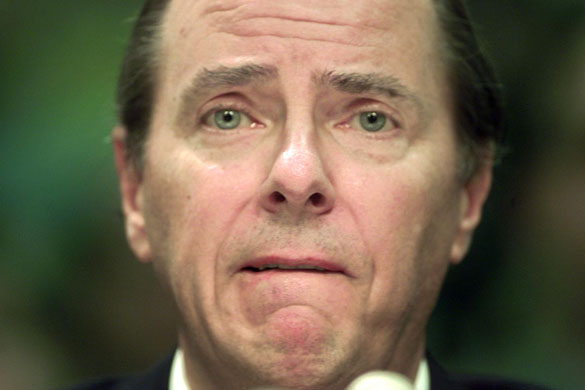
The above photo of Jeffrey Skilling testifying before Congress ran in The Guardian. Which, as I'm sure you know, is a British paper. So yes, the man's spectacular skulduggery as Enron C.E.O. made him world-famous.

Today's arguments before the Supreme Court, however, will address the issue of whether or not in this, the Internet age, did they make him too famous in Houston, Texas, to get a fair trial?

Adam Liptak pondered this question in yesterday's New York Times:
A Houston Chronicle column about his trial on fraud charges was headlined “Your Tar and Feathers Ready? Mine Are.” A rap song appeared called “Drop the S Off Skilling.” And potential jurors in Mr. Skilling’s trial told the court that he was “a high-class crook” who “should be reduced to having to beg on the corner and live under a bridge.”
Not exactly dispassion on two feet, is it?

Mr. Liptak went on to point out:
It has been two decades since the Supreme Court has considered a major change of venue case, and its jurisprudence is still rooted in decisions based on small communities dominated by a single local newspaper and perhaps a few local television news outlets. The law has been slow to adapt to a more general, more intense and yet more atomized media environment.
How potential jurors become informed in the Internet era, experts in jury behavior said, cuts in two directions. It may now be harder than ever for defendants to find wholly untainted jurors in their own communities. At the same time, a change of venue in a truly high-profile case is less likely than ever to solve the problem.
In other words, when Enron sank and took many an  innocent investor and employee with it, we were all Houstonian in our anger at those responsible.

And those responsible certainly included Mr. Skilling--at least according to the Houston jury that convicted him. The question before the Supreme Court today is, was Houston, a city seething with antipathy toward Skilling, the proper venue for his trial?

In today's arguments before the Supreme Court (in a Bloomberg.com report)  . . .
The 12 jurors reflected that antipathy, Skilling contends. During pretrial questioning, three said they were “angry,” three said they had negative feelings toward Skilling or doubted his impartiality and one said that all CEOs were “greedy,” according to his appeal.
What Jeffrey Skilling wants is a new trial, somewhere else. And what I want is to know what you think--did Enron's former CEO get a fair trial? If not, where could he get one in this Internet Age? And, perhaps most tellingly, do you think you could consider evidence impartially as a Skilling trial jury member?

On appeal, incidentally, are all of Mr.Skilling's 19 convictions. According to court watchers, the Supremes have indicated that they will probably overturn at least one conviction, the one for depriving "another of the intangible right to honest services.”

The case is Skilling v. United States, 08-1394.

Note: Hear what Nina Totenberg had to say about the arguments on Monday's ATC.

Monday, October 5, 2009

The Supremes, back at it . . .

The front page of today's The New York Times sports an article slugged, "New Court Term Hints at Views on Regulating Business." In it, Michael W. McConnell, a former federal appeals court judge who is now director of the Stanford Constitutional Law Center, is quoted as saying,
“Every time in American history when you see a consequential administration,you see a heightened tension between it and the court.”
The article goes on to point out that by the time the court goes on its summer break, 25 or the 45 cases they will have heard will concern business issues. Last year 16 of 42 revolved around business.

What's at stake in these cases is government's ability to rein in the Reagan-esque deregulation of business practices that's played out over the last three decades. Since the deregulated ways of Big Business are now largely credited with bringing on our current Great Recession, the basic question the Court has to consider is what can the Federal Government do in the way of re-instituting oversight.

If you breathed a sigh of relief when the helicopter bearing the just-retired George W. Bush lifted off from Washington last January 20th, perhaps it's time to un-sigh, for his administration will remain a potent force in this country as long as we have the conservative Roberts Court.

If you are in despair over our current administration's and Democratic Congress' attempts to "meddle" in free enterprise, the thought of the Roberts Court should make you take heart.

Does Big Business know what's best for the rest of us? Think what you will, it's all up to how those 9 people in black robes think the Constitution answers that question. Back to Mr. McConnell's remark, the tension between the Judicial Branch and the rest of the Federal Government is likely to run pretty durn high. Nina Totenberg get ready!

Any thoughts about all of this?